» Press and Media
Texts and Essays
Helnwein - Faces, Edition Stemmle – November 30, 1991
HELNWEIN FACES
HELNWEIN
"I do not refer to the choice of objects, although I mean those too; above all, I refer to that expression of uniqueness, of the special quality of time that pictures can be given by artists who know what a record is. But that requires an interest in the things themselves and it is not enough to be interested in the lighting."
Bertold Brecht
Benedikt Taschen Verlag GmbH – November 30, 1991
Horror and the Transcendent
Gottfried Helnwein - Horror and the Transcendent
"Rock music, films and comic strips are the art of the 20th century: basic artforms that make a powerful impact, with elemental potency and intensity. These are the very qualities I have tended to miss in most approved works of high art. In comparison, the latter are generally bloodless and boring, and have little connection with real life and people." When Gottfried Helnwein made this assessment of contemporary art in 1990, he had long since shown in his own art that he was way ahead of his times. Yet again.
Edition Stemmle – November 30, 1991
HELNWEIN FACES
by HEINER MÜLLER
How can a friendly person like Helnwein stand making his - excellent - painting into a mirror of the terrors of this century? Or is it that he can't stand not doing it? Does his mirror just reflect the attitude of the century: Terror without end is better than an ending in terror...
Edition Stemmle – November 30, 1991
HELNWEIN FACES
by WILLIAM S. BURROUGHS
There is a basic misconception that any given face, at any given time, looks more or less the same, like a statue's face. Actually, the human face is as variable from moment to moment as a screen on which images are reflected, from within and from without. I have seen six pictures of the same subject taken in less than a minute - so different one from the other, as not to be recognizable as the same person.
Helnwein - Faces, Edition Stemmle – November 30, 1991
HELNWEIN FACES
HELNWEIN FACES
Looking at Gottfried Helnwein' portraits, we once again experience the shock of the new, of an unprecedented view of the person opposite.
I have observed many people confronted with these portraits for the first time and again and again they would show surprise, intensity of experience and fascination.
Helnwein's portraits can be seen as counterpoles to the technically sophisticated smoothnes of the portraits of Robert Mapplethorpe.
Catalogue,museum of lower Austria – November 30, 1990
Installation at the Niederösterreichisches Landesmuseum in the Minoritenkirche Krems/Stein, 26. May - 7. July 1991
"KINDSKOPF", Helnwein's plea for a different childhood
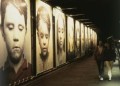
The auratic face of a child, six metres high, four metres wide, hanging in the triumphal arch of a medieval church, surrounded by dozens of canvases in the standard size of 200 by 140 cm that are mounted on the church's pillars and walls show heads and fantasy creatures which only on closer inspection may be easily recognized as children's drawings - once more Helnwein upsets traditional structures of perception in a number of ways, including the expectations that visitors have of a Helnwein exhibition. This is signalled already by the title "KINDSKOPF", which in addition to being a reference to the theme depicted (the head of a child) refers to the ironically serious self-representation of the artist (in German "Kindskopf" is a somewhat condescending colloquialism for an adult acting in childish ways), similar to Helnwein's earlier catalogue title "Subhuman" ("Untermensch") of 1988.
polyaisthesis – 30. November 1989
Internationale Gesellschaft für Polyästhetische Erziehung, Hochschule für Musik und Darstellende Kunst, Mozarteum, Salzburg
Erstickter Schrei
Über Kunst und ihre Botschaft im postmodernen Dschungel transkultureller Rätsel
An dieser Stelle sollen nun drei Beispiele diskutiert werden, Bilder von Klaus Staeck, Gottfried Helnwein und Paolo Baratella, die das ästhetische Programm der Protestmalerei bis zum gesellschaftlichen Eklat getrieben haben.
Katalog, Folkwang Museum Essen – 30. November 1988
one man show, Folkwang Museum Essen, Germany
GOTTFRIED HELNWEIN oder die Welt hinter den Dingen, Eine Betrachtung
Gottfried Helnwein or The World behind the Objects
Wenn wir von Helnwein sagen, er habe von aussen nach innen gemalt, dann heisst das,daß seine minutiöse und bohrend-insistierende Arbeitsweise, die die geschaute Wirklichkeit brutal interpretiert,
eine hinter den Dingen im Verborgenen liegende Welt aufzudecken versucht.
DAS GROSSE LEXIKON DER GRAPHIK, Tigris, Köln – 30. November 1988
DAS GROSSE LEXIKON DER GRAPHIK
Künstler Techniken Hinweise für Sammler
Catalogue, Ninth of November Night – November 30, 1987
Installation between Museum Ludwig and the Dome of Cologne
SELECTION
With the Installation "Ninth of November Night" Gottfried Helnwein wanted ti remind us of the "Reichskristallnacht", November 9th to 10th, 1938.
He has consciously foregone using documentary archive material.
He is chiefly interested in the attitude behind the catastrophe, the roots of the holocaust - the delusion that one is able to measure the worthiness or unworthiness of humans by the form of the nose and ears, by the hair and colour of the eyes.